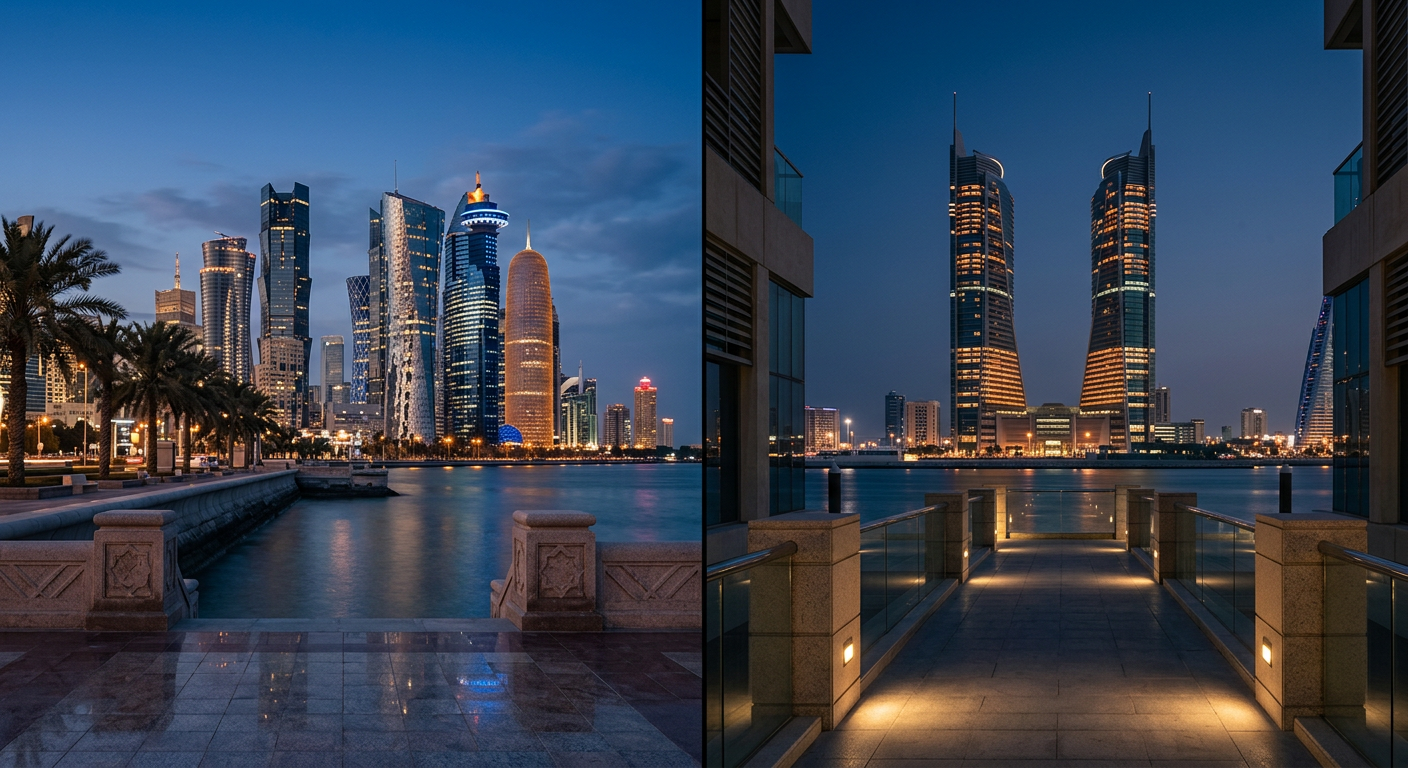
Doha vs Manama: Which Gulf Capital Suits the Discerning Traveller
Doha and Manama are an hour’s flight apart, both face the same warm water, and answer entirely different questions for the visitor. Doha is a capital built to be seen — architecture as statement, hotels as monuments, the World Cup still echoing in its planning. Manama is the opposite intuition — a small island capital with the temperament of a coastal town that happens to have a financial district. A trip that mistakes one for the other ends the wrong way.
This is a comparison for travellers who care less about which city is “better” and more about which city fits the brief of the particular week ahead.
Two Capitals, Two Temperaments
Doha presents. Manama unfolds. That is the shortest version.
In Doha, the visible architecture has been designed for the long shot. The Museum of Islamic Art sits alone on a peninsula. The Corniche is six kilometres of curve. The skyline along West Bay was built to be photographed from the water. The city is, in the best sense, a stage — well-lit, considered, and aware of being watched.
In Manama, the architecture is denser, older in patches, and arranged for inhabitants rather than spectators. The Bahrain World Trade Center sits in a corner of the city rather than at its centre. The old quarter, Muharraq, is a five-minute drive from the financial district and feels like a different decade. Manama is a place that lets a visitor turn down the volume.
Arrival and First Impressions
Hamad International Airport in Doha is the most architecturally serious airport in the Gulf, and the arrivals process has been engineered to match. A visitor flying premium cabin moves through quickly. A visitor flying with the wrong paperwork moves through slowly. Doha rewards preparation.
Bahrain International Airport in Manama is smaller, older, and currently in the late stages of a long modernisation. The arrival is more informal. The Bahraini customs convention is faster and less procedural than the Qatari one — a function of Bahrain’s longer history with regional tourism. A visitor with normal documentation clears in fifteen minutes.
The drive from each airport to its capital is short. Doha to West Bay is twenty minutes in light traffic. Manama airport to the financial district is ten. Both cities are compact in the way that Riyadh and Dubai are not.
The Hotel Question
Doha’s hotel scene was rebuilt for the World Cup and has remained at that scale. The shortlist is short and serious.
Mandarin Oriental Doha, on Msheireb Downtown, is the city’s most considered hotel, with the staff culture and the suite design that the brand is known for. The Chedi Katara, on the beach, is the resort option — quieter, lower-rise, with a Mediterranean tempo. The Ned Doha, in the restored Ministry of Interior building, is the most architectural option and the most photographed.
Manama’s hotels are smaller, older, and more residential. Four Seasons Bahrain Bay is the island’s grand option, with its own bridge to the city and a calm waterfront. The Ritz-Carlton Bahrain is the older grand hotel, with a more traditional Bahraini hospitality. The Merchant House, an Autograph Collection property in the old souq district, is the boutique option for visitors whose week is more cultural than commercial.
A traveller building a regional itinerary that includes the Gulf will find profiles in both Qatar and Bahrain listed in the curated companion directory, with the same emphasis on discretion that the two cities’ better hotels share.
Where to Dine, Where to Be Seen
Doha’s dining scene scaled up rapidly between 2018 and 2022 and has settled into a recognisable shape. The premium options cluster in two neighbourhoods. Msheireb Downtown is the new dining capital — Hakkasan, Idam, Nobu. The Pearl-Qatar is the second cluster, more international, more visible. La Mar, Megu and Toro Toro are the headline names. Reservations are necessary; walk-ins at the better restaurants do not happen.
Manama’s dining scene is less monumental and more interesting at the middle range. The Bahraini old town has small restaurants that have been there for two generations. The waterfront at Bahrain Bay is a newer cluster — Cipriani, Roberto’s, Mosaic at the Four Seasons. The premium scene in Manama feels less performed than in Doha; the better tables are often the unflashy ones.
For visitors building the trip around being seen, Doha is the answer. For visitors building it around dining well in quieter rooms, Manama is.
Rules, Limits and What “Liberal” Actually Means in Manama
Both countries are Gulf states with conservative legal frameworks. The visitor-facing reality is, however, different.
Doha treats alcohol as a hotel-only matter. Licensed venues exist exclusively inside international hotels, and dress codes are formal in those venues. Public drinking is not part of the visible culture. The city’s social scene is consequently more interior and more concentrated.
Manama treats alcohol as a normal feature of restaurant life. Licensed venues exist throughout the city, including outside hotel grounds, and the regulatory framework is older and looser than Qatar’s. This is what is meant when Manama is called “liberal” within the Gulf — not that the country is unrestrained, but that the public-facing social life is more visible.
Local regulations vary across the region and change over time, and a visitor should check the current position with the hotel concierge on arrival rather than relying on general impressions.
Which City for Which Trip
A working summary:
Choose Doha for a trip built around important meetings in serious settings, for hotel-centred evenings in monumentally designed rooms, and for a visit where the cityscape itself is part of the brief. Doha is the answer when the trip needs to look like itself.
Choose Manama for a trip with a more domestic tempo, for evenings that move between hotel, restaurant and waterfront without much sense of being staged, and for visitors whose week has space for the cultural quarter as much as the financial one. Manama is the answer when the trip should feel less observed.
A useful second opinion on each city is available through Condé Nast Traveler’s Gulf coverage and the editorial archive at Monocle, both of which read the two cities accurately and without exaggeration.
Editorial Team, Asia-Escort
External links used: Condé Nast Traveler, Monocle
Internal links used: https://asia-escort.net/, https://asia-escort.net/country/qatar/, https://asia-escort.net/country/bahrain/
