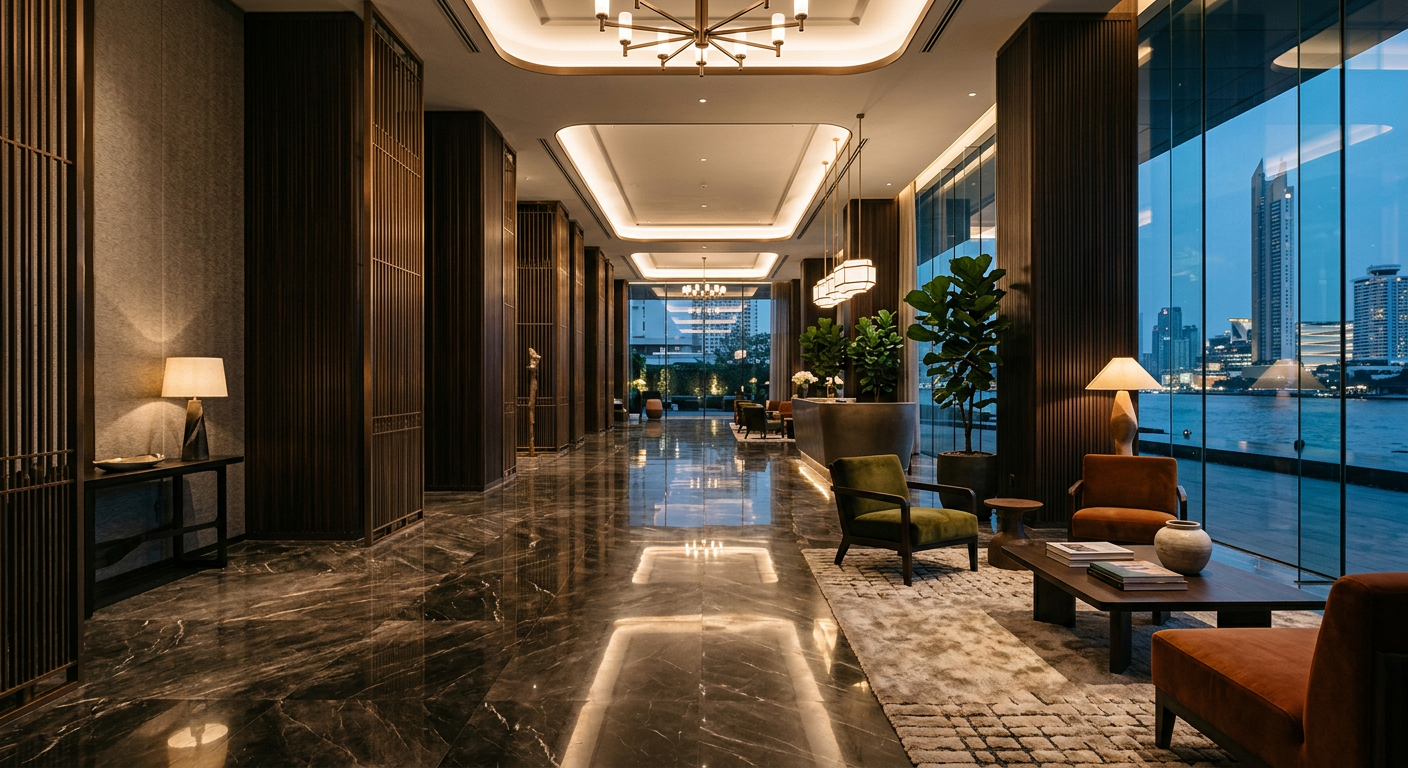
Five-Star Privacy: Comparing Lobby Policies at Top Bangkok Hotels
A hotel’s lobby is its first promise to a guest, and its first opportunity to break one. The grade of marble matters less than what the staff do when a guest crosses the floor. Some lobbies are designed to perform welcome. Others are designed to acknowledge and then disappear. In Bangkok, where the better hotels compete on standards almost identical at the surface, the lobby policy is the genuine differentiator.
This review compares five properties on a single dimension: how each handles the lobby moment for a guest who values discretion.
What “Privacy” Means in a Five-Star Lobby
The word is used loosely. In hospitality marketing, “privacy” can mean anything from a curtain on the entrance to a back-of-house lift. For the visitor who cares about the question seriously, three concrete things matter:
First, whether arrivals can be staged so that the guest never crosses a public floor. Second, whether companions arriving separately can join the guest in a way the lobby does not register publicly. Third, whether the staff who do see the guest treat the information as professional confidence or as a story for the shift handover. The first two are architecture. The third is culture.
Bangkok’s grand hotels handle each of these very differently, and the differences are not visible from the website.
Mandarin Oriental Bangkok: The Old-School Standard
The Mandarin Oriental has been operating on the Chao Phraya since 1876 and has the longest institutional memory of any hotel in the city. The lobby is small by modern standards, which works in the guest’s favour: the staff recognise faces within twenty-four hours and behave accordingly.
The Authors’ Wing has its own entrance from the garden, separate from the main building. Guests in the Authors’ Suites can effectively avoid the main lobby for the entire stay. River-side suites also offer a back lift accessible from the riverside boat dock — the boat from the BTS station on the opposite bank lands within the hotel grounds, and a guest can move from boat to suite without crossing reception.
Companion arrivals are handled by the concierge in a way that genuinely does not register publicly. Two staff have responsibility, neither speaks of it, and the front desk is never involved. This is the longest-established standard in the city.
Capella Bangkok: Riverside Calm and Suite Direct Access
Capella is the most architecturally considered new hotel in Bangkok and was designed with privacy as a brief, not as a feature. The lobby is large but quiet, the suites are accessed by a separate lift bank, and every category above Deluxe has direct suite check-in available on request.
The advantage at Capella is that the layout removes the lobby from the equation entirely for guests who choose. The car arrives at a porte-cochère screened from the public terrace. A concierge meets the car. The lift to the suite is direct and unshared at the higher categories. A guest who wants to skip the lobby for an entire stay can.
The disadvantage is that the staff are newer to the brand than the Mandarin Oriental team is to theirs, and the culture of discretion is still being built. The architecture is in place; the institutional memory will take a decade more.
Four Seasons at Chao Phraya: New, Glass, Watched
Four Seasons at Chao Phraya opened in 2020 with a contemporary brief — glass, river view, photographable lobby. The hotel works for guests whose trip is partly about being in a new building. It works less well for guests whose trip is about not being in a new building.
The lobby is open, visible from the riverside promenade, and the lift bank is centrally placed. Suite-level guests can request a back-of-house arrival, but it is offered rather than designed. The Sky Penthouse has its own entrance and lift, and is genuinely private — but it is one suite, and competition for it is heavy during high season.
For a business traveller whose calendar is mostly meetings and whose evenings are public, Four Seasons works. For a guest whose week is built around private movement, the architecture works against the brief.
Park Hyatt and The St. Regis: Vertical Towers, Different Rules
Both Park Hyatt Bangkok and The St. Regis sit in vertical towers in central Sukhumvit rather than on the river, and the lobby dynamics are different in towers. Both have a low public lobby on the ground floor and a sky lobby for hotel guests several floors above, accessed by a controlled lift.
Park Hyatt’s design uses the sky lobby effectively — the ground floor handles only mall and restaurant traffic; the hotel itself begins at a higher floor, behind a card-controlled lift bank. A guest’s movement from car to suite passes through one staffed check-point, the sky lobby, which by hotel design is the quietest in the city.
The St. Regis works similarly but has more retail traffic at ground level and a slightly more visible bar at the sky-lobby floor. Suite categories with butler service include an unwritten understanding around lobby movement; visitors who book without butler service do not access the same treatment.
For visitors building a longer Thailand trip, the curated companion catalogue covering Bangkok and the rest of Thailand is built around the same hotel landscape this review describes.
A Practical Comparison
A working summary, organised by priority for a privacy-conscious guest:
-
Mandarin Oriental — strongest staff culture, oldest discretion. The default choice for visitors who value being remembered without being talked about.
-
Capella — strongest architecture, newest culture. The default choice for visitors who care most about not being seen.
-
Park Hyatt — strongest tower design with the quietest sky lobby. The default choice for visitors whose week is centrally located in Sukhumvit.
-
Four Seasons Chao Phraya — strong building, weaker on the lobby brief. Works for business, less well for privacy.
-
The St. Regis — strong butler service, weaker on the public-traffic question. Works at the suite-and-butler tier, less well below it.
A second opinion from Condé Nast Traveler’s Bangkok reviews is worth reading alongside this one — their reporters spend longer in each lobby than most guests do.
Editorial Team, Asia-Escort
-
Internal links used:
https://asia-escort.net/country/bangkok/,https://asia-escort.net/country/thailand/ -
External link used: Condé Nast Traveler
